







What Is A Lift and Escalator Engineer?
Every building above two storeys depends on lifts and escalators to function. Airports, hospitals, shopping centres, residential towers, railway stations and commercial offices all rely on this equipment operating safely, reliably and in full compliance with legal requirements. When lifts and escalators fail — or worse, when they have not been properly maintained — the consequences range from costly downtime and legal liability to serious safety incidents involving members of the public.
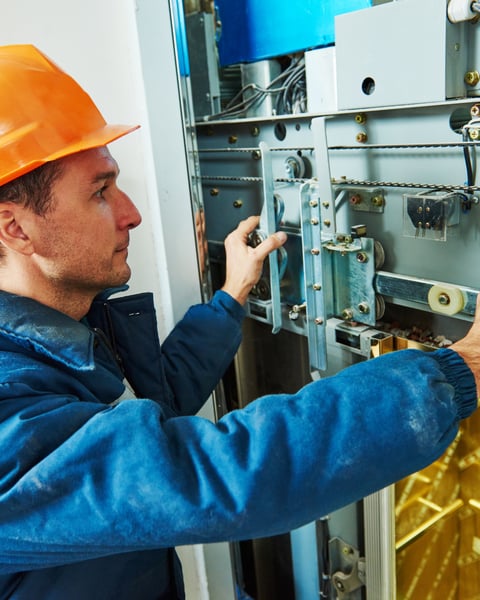
Lift and escalator engineers are the specialists responsible for preventing those failures. Depending on their chosen pathway, they install new lift and escalator systems in buildings under construction or refurbishment, or carry out the planned and reactive maintenance that keeps existing equipment safe and operational. They work with complex mechanical, hydraulic, electrical and electronic systems — from traction and hydraulic drive systems to digital and analogue control technology — ensuring that every lift or escalator they work on performs within the parameters required by UK Lift Regulations, the Supply of Machinery (Safety) Regulations, and the relevant British Standards.
This is a Level 3 apprenticeship with four specialist pathway options, delivered by Qualitrain Engineering Academy. Training can also be delivered on site at your employer's premises. The programme runs for 36 months and is funded through the Apprenticeship Levy.
Who Is It For?
Lift and escalator engineers are found across a wide range of organisations — specialist lift and escalator installation and maintenance companies, facilities management providers, construction contractors, building services firms, and large organisations that operate and maintain their own building infrastructure. The occupation spans both the installation of new systems and the ongoing maintenance and repair of existing equipment across domestic, commercial, industrial and public environments.
This programme is ideal for individuals entering the lift and escalator engineering sector at the start of their career, or for existing employees with practical experience who want to gain a nationally recognised qualification that reflects the depth of their technical knowledge. Whether you are developing new talent or upskilling your current maintenance team, this apprenticeship provides a rigorous, structured pathway to competence.
Typical job titles associated with this apprenticeship include:
- Lift Engineer
- Lift Fitter
- Lift Installation Engineer
- Lift Installer
- Lift Maintainer
- Lift Maintenance Engineer
- Escalator Engineer
- Escalator Fitter
- Escalator Installation Engineer
- Escalator Installer
- Escalator Maintainer
- Escalator Maintenance Engineer
Choosing Your Pathway
This apprenticeship is a core and options programme. All apprentices complete a shared core curriculum covering the underpinning knowledge, skills and behaviours common to all lift and escalator engineers. They then specialise in one of four pathway options:
- Lift Installation — installing passenger or goods carrying lift systems in new or existing buildings
- Escalator or Moving Walk Installation — installing escalators or moving walks in commercial and domestic buildings
- Lift Maintenance and Repair — maintenance and repair of existing passenger or goods carrying lifts
- Escalator or Moving Walk Maintenance and Repair — maintenance and repair of existing escalators and moving walks
Qualitrain Engineering Academy delivers all four pathways. We work with employers to identify the most appropriate pathway or combination of pathways for their workforce before the programme begins. Get in touch to discuss your team's requirements.
Typical Attributes Gained by Candidates
Depending on the chosen pathway, carries out the installation of lift systems, escalators or moving walks — including measuring and setting out, installing suspension systems, machines, control systems and door equipment — or conducts planned and reactive maintenance and repair of existing systems to manufacturer specifications and British Standards.
Works in strict accordance with health and safety regulations, industry codes of practice and British Standards including BS 7255 (safe working on lifts) and BS 7801 (safe working on escalators). Applies safe systems of work when taking equipment out of service, accessing lift pits and top of car spaces or escalator bottom return areas, and returning equipment to service. Understands fire safety requirements and the needs of vulnerable building users.
Diagnoses faults using electrical measuring equipment, wiring diagrams, mechanical drawings and on-board diagnostic tools. Applies structured fault-finding techniques to identify issues across mechanical, electrical, hydraulic and control systems, and makes sound decisions about component adjustment, repair or replacement.
Records all work activities accurately in electronic or paper-based formats — including job sheets, risk assessments, maintenance records, test results, handover documents and on-site checklists. Interprets and uses engineering documentation including manufacturer manuals, construction drawings, electrical diagrams and general arrangement drawings.
Communicates effectively with customers, building trades colleagues, and senior stakeholders — adapting style to the audience and using non-verbal communication effectively in field environments. Contributes to continuous improvement, manages their professional development, and works collaboratively across trades and disciplines on complex building projects.
What Skills and Knowledge Will Be Achieved?
Apprentices develop a comprehensive engineering knowledge base and practical skills toolkit — covering the full scope of lift and escalator systems, from mechanical and hydraulic principles through to digital control technology, regulatory compliance, and safe working practices specific to the sector.
At Qualitrain Engineering Academy, technical training is delivered alongside the professional disciplines that define effective engineers in a customer-facing, safety-critical environment — including structured problem-solving, continuous improvement techniques, and the professional behaviours that employers and clients expect on site. The curriculum explicitly includes Lean Six Sigma and PDCA methodology as continuous improvement tools — an addition that reflects Qualitrain Engineering Academy's broader expertise in operational improvement.
Lift and Escalator Engineering: Knowledge and Skills Overview
- Health and Safety Legislation: HSWA, LOLER, PUWER, COSHH, CDM Regulations, Building Safety Act, Working at Height
- Environmental and Sustainability Regulations and Hazard Management
- Method Statements, Risk Assessments and Safe Systems of Work
- Mechanical Principles: SI Units, Material Failure Modes, Fluid Power Transmission, Static and Dynamic Loading
- Electrical Principles: Three Phase and Single Phase Systems, AC and DC Theory, Motors and Electromagnets
- Analogue and Digital Control Systems: Operation, Installation and Maintenance
- Fault Finding and Diagnostic Methods: Electrical Measuring Equipment, Multi-meters, Electronic Diagnostic Tools
- Tools, Mechanical Measuring Devices and Alignment Equipment: Use and Calibration
- Manual and Mechanical Handling: Load Management, Lifting, Hoisting and Rigging
- Fire Safety Measures and Vulnerable People Requirements in Lift and Escalator Environments
- Engineering Documentation: Manufacturer Manuals, Wiring Diagrams, Mechanical and Construction Drawings
- Lift Installation: Measuring and Setting Out, Suspension Systems, Machines, Control Systems, Door Systems
- Escalator and Moving Walk Installation: Truss, Steps, Pallets, Handrails, Chains, Safety Sensors
- Lift Maintenance and Repair: Door Systems, Suspension Compliance, Positioning Systems, Travel Requirements
- Escalator Maintenance and Repair: Safety Systems, Tensioning Systems, Parts Removal and Replacement
- Taking Equipment Out of Service and Returning to Service: Procedures and British Standards
- Stock and Materials Management
- Documentation and Record Keeping: Electronic and Paper-Based Systems
- Continuous Improvement Tools and Techniques: Lean Six Sigma, PDCA
- Teamwork Principles and Multi-Disciplinary Collaboration
- Verbal and Non-Verbal Communication Techniques
- Equality, Diversity and Inclusion
- Continuous Professional Development
What Are The Benefits For The Business?
The lift and escalator engineering sector faces a well-documented skills challenge. Equipment is becoming increasingly sophisticated — integrating digital control systems, remote diagnostics and building management interfaces — while the pool of qualified engineers who can install and maintain it to the required standard remains under pressure. For businesses that depend on this capability, developing it in-house through a structured apprenticeship is both a more reliable and more cost-effective route than competing for experienced engineers in a constrained market.
A competently trained lift and escalator engineer brings fully verified competence across their chosen pathway — assessed independently at the end of the programme against the occupational standard. They understand the legal and regulatory framework, can work safely in confined and height-access environments, and are capable of managing the full maintenance or installation cycle without supervision from day one of qualified status.
For installation contractors, this means engineers who can contribute meaningfully to new build and refurbishment projects from an early stage in their training. For maintenance and service businesses, it means a pipeline of engineers capable of managing planned maintenance schedules, responding to reactive callouts, and maintaining the documentation standards that compliance and client contracts demand. Either way, the programme is fully funded through the Apprenticeship Levy — meaning you build specialist capability without drawing on operational budgets.
On successful completion, apprentices achieve professional recognition aligned with the Society of Operations Engineers (SoE) at Engineering Technician level — reflecting the depth and rigour of what the programme develops.
How Long Does The Apprenticeship Take?
Typically, this apprenticeship will take 36 months to complete. Training is delivered at our training facilities or on site at your employer's premises. Register your interest now to secure priority access to programme information and funding guidance.
Is This A Government Funded Qualification?
Funding for the Lift and Escalator Engineering Apprenticeship can be accessed through the Apprenticeship Levy. If you do not pay the Apprenticeship Levy, the Government will co-invest and fund 95% of the cost of the apprenticeship. The maximum funding band for this standard is £25,000.
If you have any questions about funding, Qualitrain Engineering Academy's team is here to help — from setting up your Digital Apprenticeship Account through to identifying the right funding route for your business and your apprentices.
What Our Clients Say About Us
Our Accreditations & Awards
Contact Information
Address: Genesis Centre, 32-46 King Street, Alfreton, Derbyshire, DE55 7DQ
Phone Number: 01773 417340
Email Address: info@qualitrain.co.uk
Get In Touch With Us!
From Our Blog
Stay up to date with what is new in our industry, learn more about the upcoming products and events.

IPAF MEWP Courses: Ensuring Legal Compliance For Powered Access Equipment Operations

How Does A Lean Manufacturing Operative Apprenticeship Help To Reduce Waste?